UK Redundancy Pay Calculator 2026
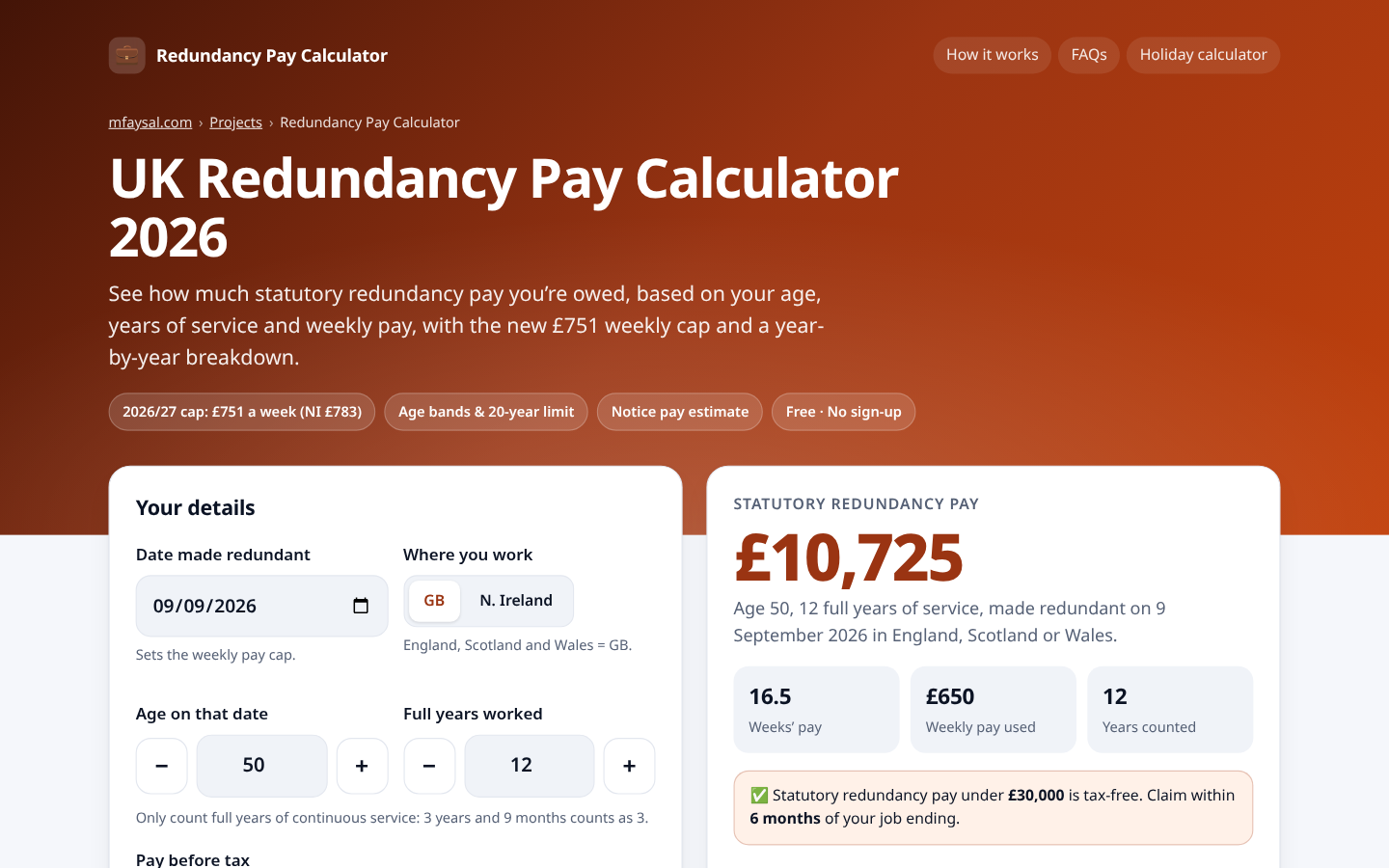
A free UK statutory redundancy pay calculator I built with plain JavaScript. It uses the GOV.UK age bands, the 20-year limit and the 2026 weekly cap of £751 (£783 in NI), with a year-by-year breakdown.
A project I built. The summary below is what it does. I can build this kind of page for a business.
- HTML
- CSS
- JavaScript
- Node test runner
- Vercel
- Frontend
The UK Redundancy Pay Calculator works out the statutory redundancy pay you are owed from four answers: the date you were made redundant, your age on that date, your full years of service and your pay before tax. It counts each year back from the redundancy date and applies the GOV.UK age bands: half a week's pay for each full year under 22, one week from 22 to 40 and one and a half weeks at 41 or older, with only the last 20 years counted.
Weekly pay is capped by date. For redundancies on or after 6 April 2026 the cap is £751 in England, Scotland and Wales and £783 in Northern Ireland, so the maximum payment is £22,530 (£23,490 in NI). The 2025/26, 2024/25 and 2023/24 caps are built in for older dates, and monthly or yearly pay is converted to a weekly figure.
The results show the total, the weeks of pay, a table by age band and a timeline of every counted year. They also show the statutory notice period, notice pay and what the payment would be without the cap. Results can be shared by URL, copied or printed.
It is plain HTML, CSS and JavaScript with no build step, no tracking and no API key. The calculation is unit-tested against figures from the official GOV.UK redundancy pay calculator, and the page has FAQ, WebApplication and breadcrumb structured data.
// context
How this page fits the rest of the site.
UK Redundancy Pay Calculator 2026 is work I built and can extend. The summary above is the scope of this repository. A business version can add accounts, a server, or a design that matches the brand.
Technologies are the ones listed on the card. A live demo button appears only when a page is actually published. GitHub is the source. If the repository and this write-up disagree, trust the repository and send a correction from the contact page.