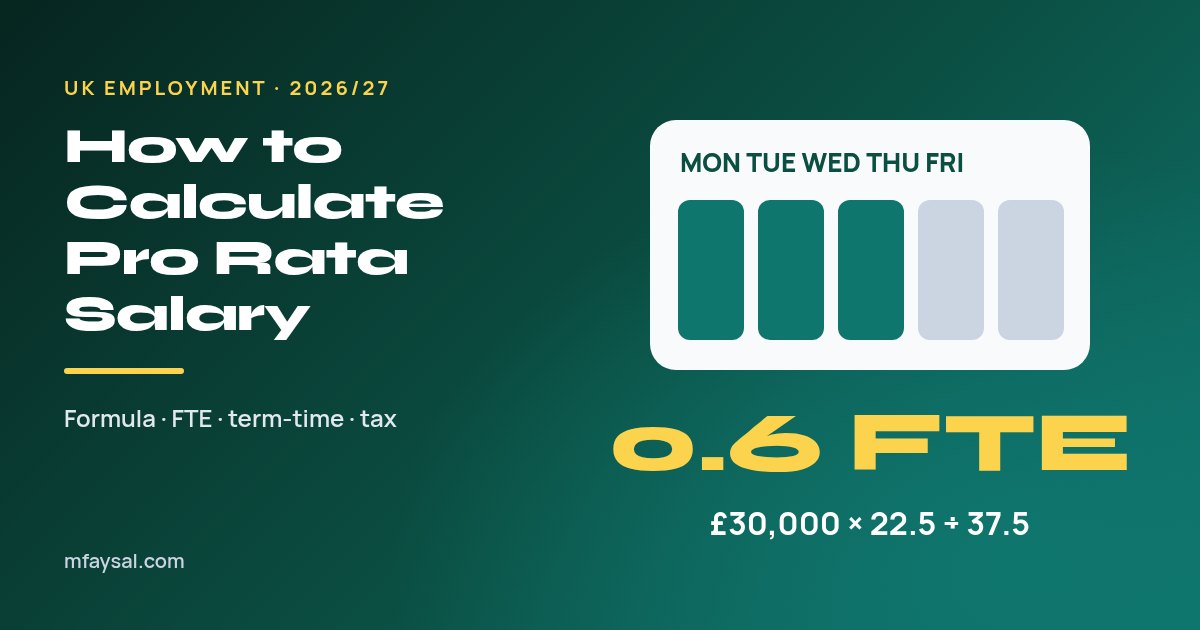
To calculate a pro rata salary in the UK, multiply the full-time salary by your contracted weekly hours divided by the full-time weekly hours. For example, a £30,000 job based on 37.5 hours pays £30,000 × (22.5 ÷ 37.5) = £18,000 if you work 22.5 hours a week.
That one line covers most job adverts. The trouble starts with the details: which full-time week your employer uses, how they count days in a part month, how term-time weeks work, and what happens to holiday and tax.
This guide walks through each of those with real numbers, so you can check an offer or a payslip yourself. Once you have your pro rata figure, the take-home pay calculator shows what actually lands in your bank account.
In this guide:
- What pro rata salary and FTE mean
- The pro rata salary formula, step by step
- The 37.5 vs 40 hour trap
- Pro rata salary for 1 to 4.5 days a week
- Hourly and daily rates: 52 vs 52.143 weeks
- Starting or leaving part-way through a month
- Term-time pro rata: a worked example
- Pro rata holiday entitlement
- Check pro rata pay against the minimum wage
- Your right to equal treatment as a part-timer
- Tax on part-time pay in 2026/27
- A quick pro rata payslip checklist
- Frequently asked questions
What pro rata salary and FTE mean
"Pro rata" is Latin for "in proportion". A pro rata salary is the slice of a full-time salary that matches the share of full-time hours you work.
Job adverts usually show the full-time figure with a note such as "£30,000 FTE" or "£30,000 pro rata". FTE stands for full-time equivalent. It's the salary you'd earn if you worked the full-time week, not what you'll actually be paid.
Your FTE fraction is simply your hours divided by full-time hours. Someone on 22.5 hours out of 37.5 is 0.6 FTE, or 60%. If you prefer to think in percentages, a percentage calculator turns any hours split into a percentage in seconds.
The pro rata salary formula, step by step
Here's the method most UK payroll teams use:
- Find the full-time annual salary for the role (the FTE figure).
- Find the full-time weekly hours your employer uses for that role.
- Divide your contracted weekly hours by those full-time hours.
- Multiply the full-time salary by that fraction.
Pro rata salary = FTE salary × (your weekly hours ÷ full-time weekly hours)
Worked example: the role pays £32,000 FTE on a 37.5-hour week, and you'll work 20 hours. 20 ÷ 37.5 = 0.5333, and £32,000 × 0.5333 = £17,066.67 a year, or £1,422.22 a month.
Use hours rather than days whenever you can. Three days a week sounds like 60% of a five-day week, but if your days are longer or shorter than a full-timer's days, the fraction changes.
The 37.5 vs 40 hour trap
The denominator matters more than most people expect. There's no single legal full-time week in the UK. GOV.UK's part-time workers' rights guidance says there's no set number of hours, though full-time usually means 35 hours or more.
So one employer's full time might be 35 hours, another's 37.5 and another's 40. Take the £32,000 role above with a 20-hour contract:
| Full-time week used | FTE fraction | Pro rata salary | Hourly rate |
|---|
| 37.5 hours | 0.5333 | £17,066.67 | £16.37 |
| 40 hours | 0.5000 | £16,000.00 | £15.34 |
| Difference | - | £1,066.67 a year | £1.03 an hour |
Same advert, same 20 hours, and a £1,066.67 gap. If the advert doesn't say which full-time week the salary is based on, ask before you accept. The right answer is the full-time hours of a comparable full-time worker in that role, not a number someone picks for convenience.
Pro rata salary for 1 to 4.5 days a week
This table assumes a £30,000 FTE salary, a 37.5-hour full-time week and equal 7.5-hour days. Swap in your own salary by multiplying it by the FTE column.
| Days a week | Weekly hours | FTE | Annual salary | Monthly gross |
|---|
| 1 | 7.5 | 0.2 | £6,000 | £500 |
| 2 | 15 | 0.4 | £12,000 | £1,000 |
| 2.5 | 18.75 | 0.5 | £15,000 | £1,250 |
| 3 | 22.5 | 0.6 | £18,000 | £1,500 |
| 4 | 30 | 0.8 | £24,000 | £2,000 |
| 4.5 | 33.75 | 0.9 | £27,000 | £2,250 |
A four-day week on full-time pay is a different deal entirely. In that case your hours drop but your salary doesn't, so nothing is pro rated.
Hourly and daily rates: 52 vs 52.143 weeks
Turning an annual salary into an hourly or daily rate sounds easy, but payroll teams use different year lengths.
- Weeks: a 365-day year is 365 ÷ 7 = 52.143 weeks. A leap year is 52.286. Some employers round to 52.
- Working days: 2026 and 2027 each have 261 weekdays, while 2028 has 260. Some employers use 260 as a fixed figure instead.
Here's what those choices do to a £30,000 FTE salary on 37.5 hours:
| Rate | Using 52 weeks or 260 days | Using 52.143 weeks or 261 days |
|---|
| Weekly | £576.92 | £575.34 |
| Hourly | £15.38 | £15.34 |
| Daily | £115.38 | £114.94 |
The gaps look tiny, but they add up when you're paid for extra hours or docked for unpaid leave. Your contract or staff handbook should say which divisor applies. If it doesn't, ask payroll and keep the answer in writing. Once you have an hourly figure, the minimum wage calculator shows whether it clears the legal floor for your age.
Starting or leaving part-way through a month
If you join on the 14th, your first payslip covers only part of the month. UK law doesn't fix one method, so employers pick one and should apply it consistently to starters and leavers.
Example: you start on Wednesday 14 October 2026 on £36,000 a year (£3,000 a month). You're employed for 18 of October's 31 calendar days, and 13 of its 22 working days. A working days calculator handles that counting for any dates.
| Method | Calculation | October pay |
|---|
| Calendar days in the month | £3,000 × 18 ÷ 31 | £1,741.94 |
| Calendar days in the year | £36,000 ÷ 365 × 18 | £1,775.34 |
| Working days in the month | £3,000 × 13 ÷ 22 | £1,772.73 |
| Working days in the year (261) | £36,000 ÷ 261 × 13 | £1,793.10 |
| Working days in the year (260) | £36,000 ÷ 260 × 13 | £1,800.00 |
The spread here is £58.06 for the same 13 days of work. None of these methods is wrong. What matters is that your contract names the method and payroll follows it in both directions.
Term-time pro rata: a worked example
School support roles are often advertised as an FTE salary, then pro rated twice: once for hours and once for weeks. The second step is where mistakes creep in, because the paid weeks should include holiday, not just term weeks.
Example: a teaching assistant works 32.5 hours a week for 39 weeks. The full-time week is 37 hours and the FTE salary is £25,000.
- Hours worked in the year: 39 × 32.5 = 1,267.5.
- Holiday at the statutory 12.07% for part-year workers: 1,267.5 × 0.1207 = 153 hours, which is 4.71 weeks of 32.5 hours.
- Paid weeks: 39 + 4.71 = 43.71.
- Pro rata fraction: (32.5 ÷ 37) × (43.71 ÷ 52.143) = 0.7363.
- Salary: £25,000 × 0.7363 = £18,406.91 a year, usually paid in 12 equal instalments of £1,533.91.
Using 39 ÷ 52 without holiday would give only £16,469.59, which is £1,937.32 short. Many school employers give more holiday than the legal minimum, so your paid weeks may be higher. The 12.07% rule and who counts as a part-year worker are explained in our guide to 12.07% holiday pay.
Pro rata holiday entitlement
Almost every UK worker gets at least 5.6 weeks of paid holiday a year. For part-timers on regular hours, that's 5.6 times the days or hours you work each week, capped at 28 days.
| Days a week | Minimum days of holiday | Hours (at 7.5 hours a day) |
|---|
| 1 | 5.6 | 42 |
| 2 | 11.2 | 84 |
| 3 | 16.8 | 126 |
| 4 | 22.4 | 168 |
| 5 | 28 | 210 |
Bank holidays can count towards that minimum, which causes friction for part-timers who don't work Mondays. A fair employer pro rates bank holidays along with everything else, so you get the same total share of time off. The holiday entitlement calculator works it out in days or hours for any pattern.
Check pro rata pay against the minimum wage
Pro rating cuts your annual pay, but it never changes your hourly rate. So if the full-time salary is too low, the part-time version is too low as well.
From April 2026, the National Minimum Wage rates are £12.71 an hour at 21 and over, £10.85 at 18 to 20, and £8 for under-18s and first-year apprentices.
Quick test: divide the FTE salary by (full-time hours × 52.143). A £24,500 FTE role on 37.5 hours works out at £12.53 an hour, which is below £12.71 for anyone aged 21 or over. To pass, that role needs at least £24,852.59 FTE on 37.5 hours, £26,509.43 on 40 hours or £23,195.75 on 35 hours.
The legal test runs over each pay reference period, and some deductions count against you, so treat this as a warning sign rather than a final verdict.
Your right to equal treatment as a part-timer
Pro rata isn't just a payroll habit. It's backed by the Part-time Workers Regulations 2000, which protect part-timers from less favourable treatment than comparable full-time workers.
The regulations define the "pro rata principle": a part-timer should get at least the proportion of a full-timer's pay or benefit that matches their share of weekly hours. In practice that covers:
- the same hourly rate of pay
- bonuses in proportion (a £1,000 full-time bonus becomes £500 at half the hours)
- holiday, sick pay and family leave pay
- pension access, training and promotion chances
Two caveats. Overtime premiums may only start once you pass the full-time hours, and an employer can treat part-timers differently if it can objectively justify it. If you think you've been treated unfairly, you can ask in writing for a written statement of reasons, which your employer must give within 21 days.
Tax on part-time pay in 2026/27
Part-timers usually keep a bigger share of their gross pay. That's because the tax-free bands are fixed amounts, not percentages, so they cover more of a smaller salary.
For 2026/27, the Income Tax rates give a £12,570 Personal Allowance and 20% basic rate up to £50,270. Employee National Insurance is 8% on pay between £12,570 and £50,270 a year (£1,048 to £4,189 a month).
| FTE | Gross pay | Income Tax | National Insurance | Take-home | Kept |
|---|
| 0.4 | £12,000 | £0 | £0 | £12,000.00 | 100% |
| 0.6 | £18,000 | £1,086 | £434.40 | £16,479.60 | 91.6% |
| 0.8 | £24,000 | £2,286 | £914.40 | £20,799.60 | 86.7% |
| 1.0 | £30,000 | £3,486 | £1,394.40 | £25,119.60 | 83.7% |
Figures assume tax code 1257L, England, Wales or Northern Ireland rates, equal monthly pay, and no pension or student loan deductions. At 0.6 FTE you get 60% of the gross pay but 65.6% of the full-time take-home (£16,479.60 ÷ £25,119.60). Scottish taxpayers have different bands.
A quick pro rata payslip checklist
Before you sign a contract or query a payslip, run through these checks:
- Which full-time weekly hours is the FTE salary based on?
- Do your contracted hours match what payroll has on file?
- Which divisor is used for hourly and daily rates: 52 or 52.143 weeks, 260 or 261 days?
- How are part months calculated for starters and leavers?
- For term-time roles, do the paid weeks include holiday?
- Does the hourly rate clear the minimum wage for your age?
- Is your tax code right, and does the National Insurance match the thresholds?
That last point trips people up when they start a second job, because NI is worked out per job and per pay period. Our breakdown of National Insurance rates for 2026/27 explains the thresholds in more detail.
Frequently asked questions
What is the formula for pro rata salary?
Pro rata salary equals the full-time salary multiplied by your weekly hours divided by the full-time weekly hours. For example, £30,000 × (22.5 ÷ 37.5) = £18,000.
How much is £30,000 pro rata for 3 days a week?
It's £18,000 a year, or £1,500 a month, if a full-time week is five days and your three days are the same length as a full-timer's days.
Is pro rata salary based on 37.5 or 40 hours?
It's based on the full-time hours your employer uses for that role, which could be 35, 37.5, 40 or another figure. Check the contract, because the choice can change your pay by over £1,000 a year.
Do part-time workers pay less tax?
Yes, proportionally. The £12,570 Personal Allowance and the National Insurance threshold are fixed amounts, so they cover a larger share of a smaller salary. On £12,000 a year with tax code 1257L you'd pay no Income Tax or National Insurance in 2026/27.
Is holiday pro rata for part-time workers?
Yes. Part-timers on regular hours get at least 5.6 weeks of their normal working week, so someone working 3 days a week gets at least 16.8 days. The statutory cap is 28 days.
What does FTE mean on a UK job advert?
FTE means full-time equivalent. It's the salary for the full-time week, not the amount a part-timer will earn. Multiply it by your hours divided by full-time hours to find your actual pay.
How is pay calculated if I start mid-month?
Your employer divides your monthly or annual salary by calendar days or working days and pays you for the days you're employed. The method should be in your contract, and it can change your first payslip by tens of pounds.
Can my employer pay part-timers a lower hourly rate?
Not unless it can objectively justify the difference. The Part-time Workers Regulations 2000 protect part-timers from less favourable treatment than comparable full-time workers, including on pay rates.
Last checked: 19 October 2026. Rates, rules and app settings can change, so confirm anything important with the official source linked above.