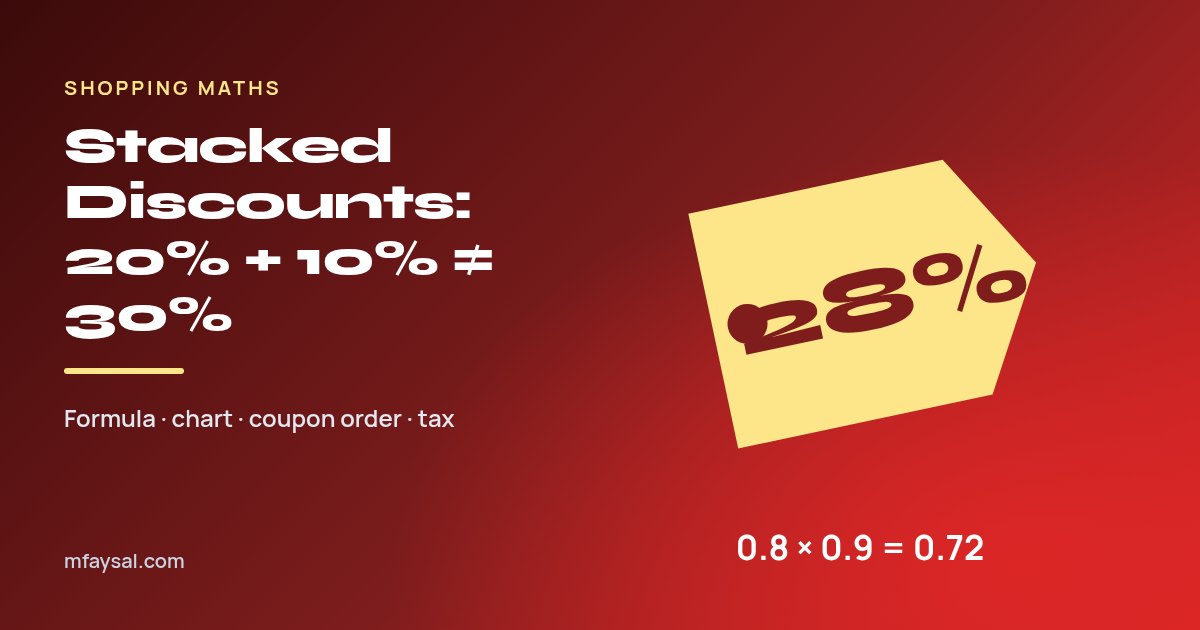
Stacked discounts multiply rather than add. To find the final price, multiply the original price by (1 − first discount) and then by (1 − second discount). So 20% off followed by an extra 10% off gives 0.8 × 0.9 = 0.72 of the price, which is 28% off, not 30%.
Shops love the "extra 10% off sale prices" banner because the headline numbers feel bigger than the real saving. That isn't a trick in itself, but it does mean you should run the numbers before you decide a deal beats a rival's flat discount.
Below you'll find the formula, a quick reference chart, how fixed-amount coupons change the order rules, how tax fits in and a few spreadsheet formulas. To check any combination in seconds, use the free discount calculator.
In this guide:
- The stacked discount formula
- Why the percentages don't simply add up
- Quick reference chart for common combinations
- Does the order of discounts matter?
- Stacked discount vs a single bigger discount
- Discounts, sales tax and VAT
- How to work backwards to the original price
- Spreadsheet formulas for stacked discounts
- Stacked discounts from the seller's side
- Sale season tips for UK and US shoppers
- Frequently asked questions
The stacked discount formula
Each discount applies to the price left after the previous one. Work with what remains rather than with what gets taken away:
- Final price = original × (1 − d1) × (1 − d2) × (1 − d3)...
- Effective discount = 1 − (1 − d1) × (1 − d2) × (1 − d3)...
- Total saving = original − final price
Write each discount as a decimal. 25% becomes 0.25, so the remaining fraction is 0.75.
Here's a full example. A £120 coat has 25% off, plus a 10% student discount. 120 × 0.75 = £90. Then 90 × 0.90 = £81. You saved £39, and the effective discount is 39 ÷ 120 = 32.5%, not 35%.
This works for any number of discounts. Three stacked reductions of 20%, 10% and 5% leave 0.8 × 0.9 × 0.95 = 0.684, an effective discount of 31.6%.
Why the percentages don't simply add up
The second discount works on a smaller number. After 20% off, you're no longer taking 10% of £100. You're taking 10% of £80, which is only £8.
Think of it as discounts on discounts. The more you stack, the bigger the gap between the headline sum and the real saving:
- 10% + 10% feels like 20%, but you get 19%.
- 30% + 20% feels like 50%, but you get 44%.
- 50% + 50% feels like 100% (free!), but you get 75%.
- 70% + 20% + 10% feels like 100%, but you get 78.4%.
That last example shows why stacked discounts can never reach 100% on their own. Each one takes a slice of what remains, so something is always left.
Here's a handy bit of mental maths for the shop floor. Add the two discounts, then subtract their product. For 30% and 20%, that's 50 minus 6 (because 0.3 × 0.2 = 0.06), giving 44%. For 25% and 10%, it's 35 minus 2.5, giving 32.5%. Once you've done it a couple of times, you can check a banner offer in your head before you even pick up the item.
If you want to explore percentages from every angle, including reverse percentages and percentage change, the percentage calculator handles those in one place.
Quick reference chart for common combinations
Save this chart for sale season. It shows the real discount for popular pairs of stacked offers.
| First discount | Extra discount | Headline sum | Real discount | £100 item costs |
|---|
| 10% | 10% | 20% | 19% | £81.00 |
| 20% | 10% | 30% | 28% | £72.00 |
| 20% | 20% | 40% | 36% | £64.00 |
| 25% | 10% | 35% | 32.5% | £67.50 |
| 30% | 15% | 45% | 40.5% | £59.50 |
| 30% | 20% | 50% | 44% | £56.00 |
| 40% | 10% | 50% | 46% | £54.00 |
| 50% | 20% | 70% | 60% | £40.00 |
| 50% | 50% | 100% | 75% | £25.00 |
| 60% | 25% | 85% | 70% | £30.00 |
The pattern is easy to spot. The gap between headline and real discount equals the two discounts multiplied together. For 20% and 10%, that's 0.2 × 0.1 = 0.02, or 2 percentage points.
Does the order of discounts matter?
For percentage discounts, no. Multiplication doesn't care about order, so 10% then 20% gives the same price as 20% then 10%.
Order matters as soon as a fixed amount joins the mix. Compare these two ways of combining 20% off with a £10 voucher on a £100 item:
| Order | Step 1 | Step 2 | Final price |
|---|
| Percentage first | £100 × 0.8 = £80 | £80 − £10 = £70 | £70 |
| Voucher first | £100 − £10 = £90 | £90 × 0.8 = £72 | £72 |
Applying the percentage first saves you £2 here, because the percentage works on the full price. As a rule:
- As a shopper, you want percentage discounts applied before fixed-amount coupons.
- As a seller, applying fixed vouchers first protects your margin.
Most checkouts decide the order for you, and the terms and conditions often spell it out. If two offers give different totals depending on order, the checkout's result is the one you'll pay.
Stacked discount vs a single bigger discount
Shops often compete with different kinds of offers. One site advertises "30% off everything" while another shouts "20% off, plus an extra 10% at checkout". Which is better?
Use the effective discount to compare like with like. The flat 30% wins, because the stacked deal only reaches 28%. On a £250 TV, that's £175 against £180.
- Convert every stacked offer to its effective discount before comparing.
- Compare final prices, not percentages, when the original prices differ.
- Factor in delivery, which can wipe out a small difference.
- Check whether the "original" price is a genuine recent selling price, not a one-day inflated figure.
That last point matters. A huge stacked discount from an inflated starting price can cost more than a modest discount from a fair one. Price tracking tools and browser extensions help you see the real price history.
Discounts, sales tax and VAT
Tax adds another layer, and where it fits depends on where you shop.
In the UK, consumer prices include VAT. A 20% discount on a £120 item takes the price to £96, VAT included. You don't need to do anything else.
In the US, sales tax is usually added at the till. Most states calculate tax on the discounted price when the store itself offers the discount. Manufacturer coupons can be treated differently, and some states tax the pre-coupon price because the store gets reimbursed.
- Store discount: tax on the reduced price in most states.
- Manufacturer coupon: rules vary, so check your state's guidance.
- Loyalty points: often treated like a store discount, though not everywhere.
If you need to back sales tax out of a total afterwards, see our guide on calculating sales tax backwards. The same "divide, don't subtract" logic applies to discounts you want to reverse.
How to work backwards to the original price
Sometimes you only know the sale price and the discounts, and you want the original. Divide by the remaining fractions instead of multiplying.
Original price = final price ÷ [(1 − d1) × (1 − d2)]
A jacket costs £63 after 30% off and an extra 10%. The remaining fraction is 0.7 × 0.9 = 0.63. Divide: 63 ÷ 0.63 = £100. That was the starting price.
This helps when you're checking that a "was" price lines up, or when you're returning an item and the refund doesn't match what you expected. Don't add the discount percentage back on top of the sale price. Adding 37% to £63 gives £86.31, which is wrong for the same reason that subtracting stacked discounts is wrong.
The same trick reverses a single discount too. A £45 item at 25% off came from 45 ÷ 0.75 = £60.
Spreadsheet formulas for stacked discounts
If you price products or compare deals in a spreadsheet, these formulas save time. Put the original price in A2 and discounts as percentages in B2, C2 and D2.
| What you want | Excel or Google Sheets formula |
|---|
| Final price, two discounts | =A2*(1-B2)*(1-C2) |
| Final price, three discounts | =A2*(1-B2)*(1-C2)*(1-D2) |
| Effective discount | =1-(1-B2)*(1-C2) |
| Original from final price | =E2/((1-B2)*(1-C2)) |
| Rounded to pence or cents | =ROUND(A2*(1-B2)*(1-C2),2) |
Format the discount cells as percentages. Typing 20 into a percentage cell stores 20%, while typing 20 into a plain number cell stores the number 20, which makes the formula return a negative price.
For a variable number of discounts, Excel's PRODUCT function helps: =A2*PRODUCT(1-B2:D2) works in Excel 365 and Google Sheets, which handle the array automatically.
Stacked discounts from the seller's side
If you run a shop, stacked offers can eat your margin faster than you expect. A sitewide 25% sale, a 10% newsletter code and a 5% loyalty reward together cut the price by 35.9%. That might be fine on a product with a 60% margin and painful on one with 30%.
- Model the worst case. Work out the effective discount if a customer stacks every code you offer at once.
- Set stacking rules. Most e-commerce platforms let you mark codes as "cannot be combined" or limit one code per order.
- Cap fixed vouchers. Apply percentage discounts after fixed amounts, or add a minimum spend, to stop small orders turning into losses.
- Exclude low-margin lines. Gift cards, clearance stock and bundles often need to sit outside extra-discount codes.
- Show the real saving. Telling customers "you saved £28.80" builds more trust than a sum of percentages that doesn't add up.
Clear pricing also keeps you on the right side of consumer law. Regulators on both sides of the Atlantic, including the CMA under the UK's Digital Markets, Competition and Consumers Act 2024, expect advertised savings to match what shoppers actually pay, so make sure the final checkout price reflects every promise on the banner.
Sale season tips for UK and US shoppers
Black Friday lands on 27 November 2026, followed by Cyber Monday on 30 November. Boxing Day and January sales follow in the UK. Stacked offers peak around these dates, so a little preparation pays off.
- Note prices now. Screenshot the items you want a few weeks early so you can spot inflated "was" prices later.
- Calculate the effective discount. Convert every stacked offer to one percentage before comparing.
- Read the voucher terms. Many extra-discount codes exclude sale items, certain brands or gift cards.
- Count delivery and returns costs. A slightly better discount with paid returns can be the worse deal.
- Know your rights. In the UK, the CMA can now fine businesses directly for misleading pricing, and in the US the FTC Guides Against Deceptive Pricing cover fake former prices.
A good deal is the one that leaves you with the item you wanted at a price you're happy with. The maths just makes sure you know what that price really is.
Frequently asked questions
Is 20% off then 10% off the same as 30% off?
No. It's 28% off. The 10% applies to the already reduced price, so you pay 0.8 × 0.9 = 72% of the original.
How do you calculate two discounts on one item?
Multiply the original price by one minus each discount as a decimal. For 25% and 10% off £80, calculate £80 × 0.75 × 0.9 = £54.
Does the order of discounts change the price?
Not for percentage discounts. It does when you combine a percentage with a fixed amount, where applying the percentage first gives the lower price.
Can stacked discounts reach 100% off?
No. Each percentage discount only takes a share of what's left, so stacking 50% and 50% gives 75% off, not 100%.
How do I find the original price from a stacked discount?
Divide the sale price by the product of the remaining fractions. A £63 price after 30% and 10% off came from 63 ÷ (0.7 × 0.9) = £100.
Is sales tax charged before or after a discount?
In most US states, sales tax applies to the price after a store discount. UK prices already include VAT, so the discount comes off the VAT-inclusive price.
How do I calculate a single percentage off?
Multiply the price by one minus the discount. For 15% off $60, calculate $60 × 0.85 = $51, which means you save $9.
What is an effective discount?
It's the single percentage that gives the same final price as several stacked discounts. For 20% and 10%, the effective discount is 28%.
Last checked: 18 October 2026. Rates, rules and app settings can change, so confirm anything important with the official source linked above.