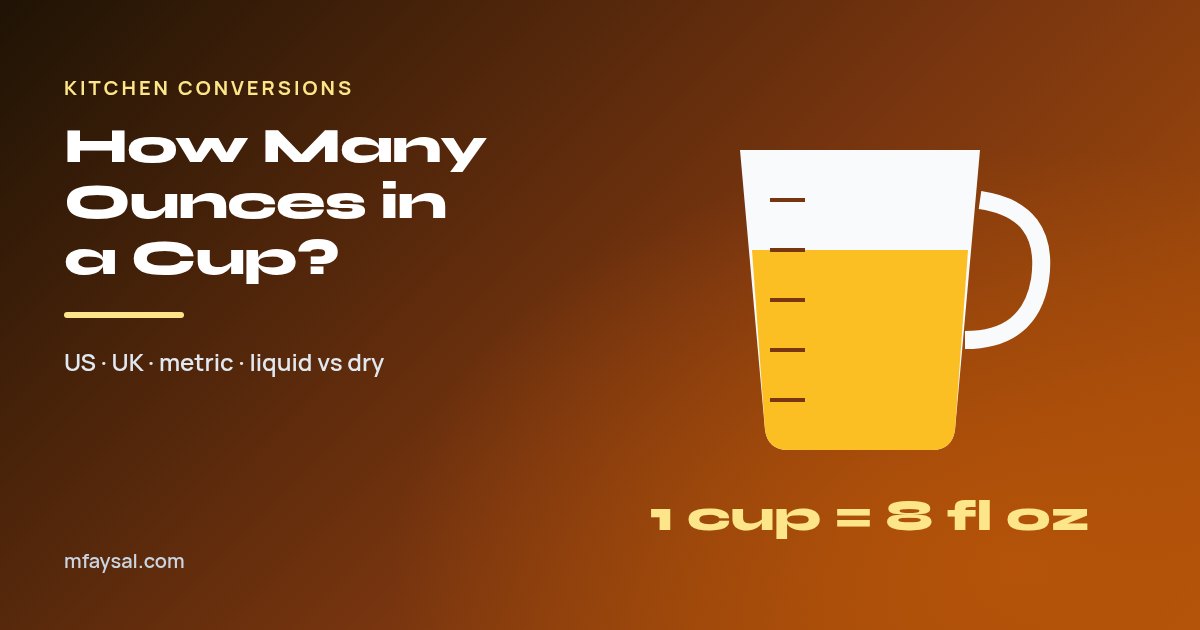
There are 8 US fluid ounces in a US cup, which is about 236.6 millilitres. But that only applies to liquids measured in US units. A UK imperial cup was 10 imperial fluid ounces (about 284 ml), a metric cup is 250 ml, and dry ingredients measured in ounces by weight don't follow the 8-ounce rule at all.
That's why a recipe can go wrong even when you follow it carefully. An American recipe asking for "1 cup flour" means about 4¼ ounces of flour by weight, not 8. A British recipe giving "8 oz flour" means 227 grams, which is almost two US cups.
This guide sorts out the different cups and ounces, gives conversion charts for liquids and common baking ingredients, and explains when to measure by weight instead. For quick sums, the ounces to cups converter handles US fluid ounces and cups.
In this guide:
- The short answer: 8 fluid ounces in a US cup
- US, UK and metric cups compared
- US vs imperial fluid ounces
- Fluid ounces vs ounces by weight
- Cups to fluid ounces chart (liquids)
- Dry ingredients: cups to ounces and grams
- Converting a British recipe in ounces to US cups
- How to measure a cup accurately
- Spoons, sticks and other US measures
- No measuring cups? Quick swaps for a UK kitchen
- Common cup and ounce mistakes
- Frequently asked questions
The short answer: 8 fluid ounces in a US cup
In the US customary system, which American recipes use:
- 1 cup = 8 US fluid ounces
- 1 US fluid ounce = 29.5735 ml
- So 1 US cup = 236.588 ml, usually rounded to 237 ml
The same system gives you the rest of the chain: 2 cups make a pint (16 fl oz), 2 pints make a quart (32 fl oz) and 4 quarts make a gallon (128 fl oz). There are also 16 tablespoons in a cup and 3 teaspoons in a tablespoon.
One more wrinkle: US food labels use a rounded "legal" cup. Under the FDA's nutrition labelling rules, a cup means 240 ml and a fluid ounce means 30 ml for labelling purposes. The difference from the customary cup is under 2%, so it won't affect your cooking, but it explains why a carton might say "1 cup (240 mL)".
US, UK and metric cups compared
"Cup" doesn't mean the same thing everywhere. Here's how the main versions compare:
| Cup | Millilitres | US fl oz | Imperial fl oz | Where you'll see it |
|---|
| US customary cup | 236.6 ml | 8.0 | 8.3 | American recipes and measuring cups |
| US legal (label) cup | 240 ml | 8.1 | 8.4 | US nutrition labels |
| Metric cup | 250 ml | 8.5 | 8.8 | Australia, New Zealand, Canada and many modern recipes |
| Old UK imperial cup | 284 ml | 9.6 | 10.0 | Older British recipes |
Modern British recipes generally avoid cups and use grams and millilitres. If a UK recipe does mention cups, check whether it's a newer recipe using a 250 ml metric cup or an older one. Most of the time the difference between a 237 ml and a 250 ml cup won't matter in cooking, but in baking it adds up across several cups.
US vs imperial fluid ounces
The fluid ounce itself differs between the two systems, which surprises many people:
- US fluid ounce: 29.5735 ml
- Imperial (UK) fluid ounce: 28.4131 ml
The US fluid ounce is about 4% larger. But the US pint holds 16 US fluid ounces (473 ml) while the imperial pint holds 20 imperial fluid ounces (568 ml). So a British pint is about 20% bigger than an American one, which is why a pint of beer in a London pub is larger than one in New York.
The imperial definitions are set in UK law. The Weights and Measures Act 1985 defines the pint as 0.568 261 25 cubic decimetres (litres) and the fluid ounce as 1/20 of a pint.
| Measure | US | UK imperial |
|---|
| Fluid ounce | 29.6 ml | 28.4 ml |
| Pint | 16 fl oz, 473 ml | 20 fl oz, 568 ml |
| Quart | 32 fl oz, 946 ml | 40 fl oz, 1,137 ml |
| Gallon | 128 fl oz, 3.785 litres | 160 fl oz, 4.546 litres |
Fluid ounces vs ounces by weight
This is the biggest source of confusion. "Ounce" can mean two completely different things:
- Fluid ounce (fl oz) is a unit of volume: how much space something takes up.
- Ounce (oz), the avoirdupois ounce, is a unit of weight: 28.35 grams, or 1/16 of a pound.
For water and most water-like liquids such as milk, juice and stock, the two line up closely: 8 fl oz of water weighs a little over 8 oz. That's why "8 ounces in a cup" seems to work for liquids.
For dry ingredients it breaks down completely. A cup of flour is mostly air between particles, so it weighs far less than 8 ounces. A cup of honey is denser than water, so it weighs more.
NIST, the US standards body, makes the same point in its culinary measurement tips: fluid ounces and ounces are different units, using dry measuring cups for liquids is a common source of error, and measuring by weight with a kitchen scale is the most accurate approach.
Cups to fluid ounces chart (liquids)
For water, milk, stock, juice and other thin liquids, using US measures.
| US cups | US fl oz | Millilitres | Tablespoons |
|---|
| ⅛ cup | 1 fl oz | 29.6 ml | 2 tbsp |
| ¼ cup | 2 fl oz | 59.1 ml | 4 tbsp |
| ⅓ cup | 2.67 fl oz | 78.9 ml | 5⅓ tbsp |
| ½ cup | 4 fl oz | 118.3 ml | 8 tbsp |
| ⅔ cup | 5.33 fl oz | 157.7 ml | 10⅔ tbsp |
| ¾ cup | 6 fl oz | 177.4 ml | 12 tbsp |
| 1 cup | 8 fl oz | 236.6 ml | 16 tbsp |
| 1½ cups | 12 fl oz | 354.9 ml | 24 tbsp |
| 2 cups (1 pint) | 16 fl oz | 473.2 ml | 32 tbsp |
| 4 cups (1 quart) | 32 fl oz | 946.4 ml | 64 tbsp |
A practical shortcut for UK kitchens: treat 1 US cup as 240 ml and use a metric measuring jug. The error is about 1.5%, smaller than the error in most people's eyeballing of a jug line.
Dry ingredients: cups to ounces and grams
For dry and solid ingredients, the weight of one cup depends on what's in it. These figures follow the King Arthur Baking ingredient weight chart, a widely used reference for American recipes.
| Ingredient (1 US cup) | Ounces (weight) | Grams |
|---|
| All-purpose (plain) flour | 4¼ oz | 120 g |
| Whole wheat flour | 4 oz | 113 g |
| Granulated sugar | 7 oz | 198 g |
| Brown sugar, packed | 7½ oz | 213 g |
| Confectioners' (icing) sugar, unsifted | 4 oz | 113 g |
| Butter (½ cup = 1 US stick) | 4 oz per ½ cup | 113 g per ½ cup |
| Rolled oats (old-fashioned) | 3⅛ oz | 89 g |
| Chocolate chips | 6 oz | 170 g |
| Milk | 8 oz | 227 g |
So "1 cup" of flour and "1 cup" of chocolate chips are the same volume, but the chips weigh about 40% more. Other references may differ by a few grams because people scoop flour differently. That variation is exactly why bakers prefer scales.
Converting a British recipe in ounces to US cups
Older British recipes list dry ingredients in ounces by weight, such as "8 oz self-raising flour, 6 oz butter, 6 oz caster sugar". To convert to cups, you need the weight of a cup of each ingredient:
- 8 oz plain flour ÷ 4¼ oz per cup ≈ 1⅞ cups (227 g)
- 6 oz butter = 1½ US sticks = ¾ cup (170 g)
- 6 oz caster sugar ÷ about 6¾ oz per cup ≈ ⅞ cup (170 g)
Notice that 8 oz of flour isn't 1 cup. It's nearly 2. This single mix-up, treating weight ounces as fluid ounces, is behind a lot of dense or crumbly bakes.
The easiest fix is to skip cups entirely: convert ounces to grams (1 oz = 28.35 g) and weigh. Our grams to pounds converter helps when recipes give pounds and ounces.
How to measure a cup accurately
If you must use cups, technique matters as much as the conversion:
- Use a liquid measuring jug for liquids. Set it on a flat surface and read the line at eye level.
- Use dry measuring cups for dry ingredients. Fill them to the top and level off with a straight knife.
- Spoon flour into the cup; don't scoop. Scooping straight from the bag packs flour down, so you end up with noticeably more than the recipe intended.
- Pack brown sugar firmly, as American recipes expect.
- Don't tap or shake the cup to settle dry ingredients unless the recipe says so.
A digital kitchen scale costs less than a set of good measuring cups and removes most of these problems. Many American recipe sites now list grams alongside cups for this reason.
Spoons, sticks and other US measures
American recipes use a few other units that confuse UK cooks:
| US measure | Equivalent | Metric |
|---|
| 1 teaspoon (tsp) | ⅓ tablespoon | 4.9 ml (5 ml on labels) |
| 1 tablespoon (tbsp) | 3 tsp, ½ fl oz | 14.8 ml (15 ml on labels) |
| 1 stick of butter | ½ cup, 8 tbsp, 4 oz | 113 g |
| 1 pint | 2 cups, 16 fl oz | 473 ml |
| 1 quart | 4 cups, 32 fl oz | 946 ml |
UK and US teaspoons and tablespoons are close enough to swap in everyday cooking. An Australian tablespoon is 20 ml, though, so watch for that if you're using an Australian recipe.
No measuring cups? Quick swaps for a UK kitchen
Many UK kitchens have a measuring jug and scales but no American cup set. Here's how to manage:
- Liquids: use 240 ml per cup on a metric jug. ½ cup is 120 ml and ¼ cup is 60 ml.
- Flour: weigh 120 g per cup of plain flour.
- Sugar: weigh about 200 g per cup of granulated sugar.
- Butter: weigh 113 g per US stick, or 227 g per cup.
- Small amounts: UK measuring spoons are close enough to US ones for teaspoons and tablespoons.
These swaps are accurate enough for almost any home recipe, and weighing is usually quicker than levelling cups anyway.
Common cup and ounce mistakes
- Treating ounces of flour as fluid ounces. 8 oz of flour is nearly 2 cups, not 1.
- Mixing up US and UK pints. A UK pint is 568 ml; a US pint is 473 ml.
- Using a coffee mug as a cup. Mugs often hold 300 to 350 ml, far more than a measuring cup.
- Scooping flour. Spoon and level instead.
- Converting each ingredient with a different system. Pick one set of measures for the whole recipe so the proportions stay right.
When in doubt, convert to grams and millilitres. Metric units are the same in every country, and they're what UK recipes use anyway.
Frequently asked questions
How many ounces are in a cup?
A US cup holds 8 US fluid ounces, about 236.6 ml. This applies to liquids. Dry ingredients weigh different amounts per cup, for example about 4¼ ounces for plain flour.
How many ounces are in a cup in the UK?
Modern UK recipes rarely use cups. An old imperial cup held 10 imperial fluid ounces, about 284 ml. Many newer recipes that mention cups mean a 250 ml metric cup, which is about 8.8 imperial fluid ounces.
Is 8 oz always 1 cup?
Only for water-like liquids measured in US fluid ounces. 8 ounces by weight of flour is nearly 2 cups, while 8 ounces by weight of honey is well under 1 cup.
How many ml is 1 cup?
A US customary cup is 236.6 ml, a US nutrition-label cup is 240 ml, a metric cup is 250 ml and an old UK imperial cup is about 284 ml.
How many cups is 16 ounces?
16 US fluid ounces is 2 US cups, or 1 US pint. For dry ingredients it depends on the ingredient; 16 ounces by weight of plain flour is about 3¾ cups.
What is the difference between fluid ounces and ounces?
A fluid ounce measures volume, while an ounce measures weight. One avoirdupois ounce is 28.35 grams. They only line up roughly for water and similar liquids.
How many ounces is half a cup?
Half a US cup is 4 US fluid ounces, about 118 ml. Half a cup of butter is one US stick, which weighs 4 ounces or 113 grams.
Is a UK pint bigger than a US pint?
Yes. A UK imperial pint is 20 imperial fluid ounces, about 568 ml, while a US pint is 16 US fluid ounces, about 473 ml. The UK pint is roughly 20% larger.
Last checked: 19 October 2026. Figures, settings and guidance can change, so confirm anything important with the sources linked above.