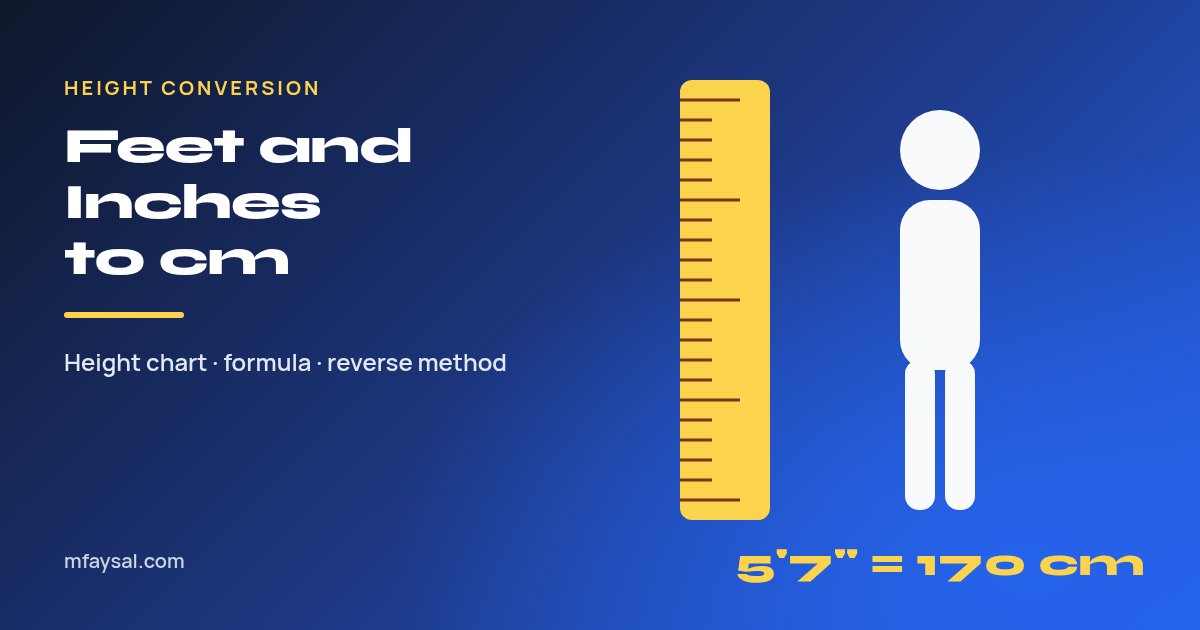
To convert feet and inches to centimetres, multiply the feet by 30.48, multiply the inches by 2.54, and add the two together. For example, 5 feet 7 inches is (5 × 30.48) + (7 × 2.54) = 152.4 + 17.78 = 170.18 cm, which rounds to 170 cm.
An easier way to remember it is to turn everything into inches first: 5 feet 7 inches is 67 inches, and 67 × 2.54 = 170.18 cm. Both methods give exactly the same answer, because the inch is defined as exactly 2.54 cm.
This guide covers the formula, a full height chart, the reverse conversion from cm back to feet and inches (where most rounding mistakes happen), average heights in the UK and US, and spreadsheet formulas. For a quick answer, the feet and inches to cm converter handles both directions.
In this guide:
- The formula for feet and inches to cm
- Why an inch is exactly 2.54 cm
- Worked examples
- Height chart: feet and inches to cm
- How to convert cm back to feet and inches
- cm to feet and inches chart
- Average height in the UK and US
- Quick mental shortcuts (and how far off they are)
- Using your height for BMI
- Feet and inches to metres
- Writing heights clearly in both systems
- Excel and Google Sheets formulas
- Frequently asked questions
The formula for feet and inches to cm
There are two equivalent ways to do the sum:
- Method 1: cm = (feet × 30.48) + (inches × 2.54)
- Method 2: cm = ((feet × 12) + inches) × 2.54
Method 2 is easier to do on a phone calculator because there's only one multiplication by 2.54 at the end. It works because there are 12 inches in a foot, and 12 × 2.54 = 30.48.
For height, round the final answer to the nearest whole centimetre, or to one decimal place if a form asks for it. Rounding in the middle of the sum makes the answer drift.
To go to metres instead, divide the centimetres by 100. So 170.18 cm is 1.70 m, the figure you'd use in a BMI calculation.
Why an inch is exactly 2.54 cm
The 2.54 figure isn't an approximation. Since 1 July 1959, the United States, the United Kingdom, Canada, Australia, New Zealand and South Africa have all used the international yard, defined as exactly 0.9144 metres. An inch is 1/36 of a yard, which makes it exactly 25.4 mm, or 2.54 cm.
The US National Institute of Standards and Technology explains the history on its page about SI units of length. Before 1959, the American and British inches differed very slightly, by a few parts per million, which mattered to engineers but not to anyone measuring their height.
So when you convert feet and inches to cm, any difference between two calculators comes from rounding, not from different definitions.
Worked examples
Example 1: 5 feet 4 inches
- 5 × 12 = 60 inches, plus 4 = 64 inches.
- 64 × 2.54 = 162.56 cm, about 163 cm.
Example 2: 6 feet 1 inch
- 6 × 12 = 72, plus 1 = 73 inches.
- 73 × 2.54 = 185.42 cm, about 185 cm.
Example 3: 5 feet 10½ inches
- 5 × 12 = 60, plus 10.5 = 70.5 inches.
- 70.5 × 2.54 = 179.07 cm, about 179 cm.
Half and quarter inches are common on US forms and in UK sizing charts. Convert the fraction to a decimal first: ¼ = 0.25, ½ = 0.5 and ¾ = 0.75.
Example 4: 4 feet 11 inches
- 4 × 12 = 48, plus 11 = 59 inches.
- 59 × 2.54 = 149.86 cm, about 150 cm.
Height chart: feet and inches to cm
This chart covers adult heights from 4'10" to 6'6", rounded to one decimal place.
| Feet and inches | Total inches | Centimetres |
|---|
| 4'10" | 58 | 147.3 cm |
| 4'11" | 59 | 149.9 cm |
| 5'0" | 60 | 152.4 cm |
| 5'1" | 61 | 154.9 cm |
| 5'2" | 62 | 157.5 cm |
| 5'3" | 63 | 160.0 cm |
| 5'4" | 64 | 162.6 cm |
| 5'5" | 65 | 165.1 cm |
| 5'6" | 66 | 167.6 cm |
| 5'7" | 67 | 170.2 cm |
| 5'8" | 68 | 172.7 cm |
| 5'9" | 69 | 175.3 cm |
| 5'10" | 70 | 177.8 cm |
| 5'11" | 71 | 180.3 cm |
| 6'0" | 72 | 182.9 cm |
| 6'1" | 73 | 185.4 cm |
| 6'2" | 74 | 188.0 cm |
| 6'3" | 75 | 190.5 cm |
| 6'4" | 76 | 193.0 cm |
| 6'5" | 77 | 195.6 cm |
| 6'6" | 78 | 198.1 cm |
Each extra inch adds 2.54 cm, and each extra foot adds 30.48 cm. The symbols ' and " are shorthand for feet and inches.
How to convert cm back to feet and inches
Going the other way takes three steps, and it's where most online answers go wrong.
- Divide the centimetres by 2.54 to get total inches.
- Divide the total inches by 12. The whole number is the feet.
- Work out the leftover inches: total inches minus (feet × 12). Round that to the nearest inch, or half inch.
Example: 180 cm.
- 180 ÷ 2.54 = 70.87 inches.
- 70.87 ÷ 12 = 5.906, so 5 feet.
- 70.87 − 60 = 10.87 inches, which rounds to 11 inches.
So 180 cm is about 5'11".
The common mistake is reading 5.906 feet as "5 feet 9 inches". The .906 is a fraction of a foot, not inches. 0.906 × 12 = 10.87 inches. Never read the decimal part of feet as inches.
Watch for a rounding trap too. 182.8 cm is 71.97 inches, which is 5 feet and 11.97 inches. Rounding gives "5 feet 12 inches", which should be written as 6'0".
cm to feet and inches chart
Here are common metric heights converted back, with leftover inches to one decimal place.
| Centimetres | Total inches | Feet and inches |
|---|
| 150 cm | 59.1 | 4'11.1" |
| 155 cm | 61.0 | 5'1.0" |
| 160 cm | 63.0 | 5'3.0" |
| 165 cm | 65.0 | 5'5.0" |
| 170 cm | 66.9 | 5'6.9" |
| 175 cm | 68.9 | 5'8.9" |
| 180 cm | 70.9 | 5'10.9" |
| 185 cm | 72.8 | 6'0.8" |
| 190 cm | 74.8 | 6'2.8" |
Round the inches to suit the purpose. Most people quote height to the nearest inch, so 175 cm becomes 5'9" and 170 cm becomes 5'7". For converting other lengths, such as room sizes or furniture, the length converter covers mm, cm, metres, feet, yards and miles.
Average height in the UK and US
Official surveys measure height rather than asking people, which makes them more reliable than self-reported figures.
| Group | Average height (cm) | Feet and inches (approx.) | Source and years |
|---|
| Men, England | 175.8 cm | 5'9" | Health Survey for England 2024 |
| Women, England | 162.1 cm | 5'4" | Health Survey for England 2024 |
| Men, United States | 175.0 cm (68.9 in) | 5'9" | CDC NHANES, Aug 2021 to Aug 2023 |
| Women, United States | 161.3 cm (63.5 in) | 5'3½" | CDC NHANES, Aug 2021 to Aug 2023 |
The England figures come from NHS England's Health Survey for England 2024, which covers adults aged 16 and over. It also notes that average height has risen by less than 2 cm for men and just over 1 cm for women since 1993.
The US figures are for adults aged 20 and over. The US survey publishes heights in inches, so the centimetre values here are converted with the exact 2.54 factor.
Quick mental shortcuts (and how far off they are)
If you don't have a calculator, two rough rules help:
- 1 foot ≈ 30 cm (exact: 30.48 cm)
- 1 inch ≈ 2.5 cm (exact: 2.54 cm)
For 5'7", the shortcut gives (5 × 30) + (7 × 2.5) = 167.5 cm, against the exact 170.2 cm. That's 2.7 cm short, just over an inch, which matters on a form or a medical record.
A better quick method: take total inches and multiply by 2.5, then add 2% of the result. For 67 inches: 67 × 2.5 = 167.5, plus 2% (about 3.4) = 170.9 cm. That's within 1 cm of the exact answer.
For anything official, such as a passport application, a visa form or an NHS or GP record, use the exact conversion and round only at the end.
Using your height for BMI
Body mass index uses height in metres, squared. BMI = weight (kg) ÷ height (m)². So if you know your height in feet and inches, convert to metres first.
Example: someone 5'10" (177.8 cm, or 1.778 m) who weighs 75 kg has a BMI of 75 ÷ (1.778 × 1.778) = 75 ÷ 3.161 = 23.7.
Small height errors have a surprisingly large effect, because height is squared. Using the rough 1 inch ≈ 2.5 cm rule for that same person gives 175 cm and a BMI of 24.5 instead of 23.7.
The BMI calculator accepts metric or stones and pounds, so you can skip the conversion. BMI is a screening measure only; it doesn't tell the difference between muscle and fat, and a health professional can interpret it properly.
Feet and inches to metres
Some forms, sports profiles and medical calculators ask for height in metres rather than centimetres. Convert to centimetres first, then divide by 100.
| Height | Centimetres | Metres |
|---|
| 5'0" | 152.4 cm | 1.52 m |
| 5'3" | 160.0 cm | 1.60 m |
| 5'6" | 167.6 cm | 1.68 m |
| 5'9" | 175.3 cm | 1.75 m |
| 6'0" | 182.9 cm | 1.83 m |
| 6'3" | 190.5 cm | 1.91 m |
Two decimal places in metres is the same precision as a whole centimetre, which is as precise as most height measurements really are. For smaller measurements, such as a child's foot length or a phone screen, millimetres are often more useful, and the inches to mm converter gives exact values using 25.4 mm per inch.
Writing heights clearly in both systems
A few conventions help avoid confusion, especially in documents read on both sides of the Atlantic:
- Feet and inches: write 5'7" or 5 ft 7 in. Avoid "5.7 ft", which readers may take as 5 feet 7 inches when it actually means 5 feet 8.4 inches.
- Metric: write 170 cm or 1.70 m, with a space between the number and the unit.
- Both at once: on a CV, profile or international form, giving both, such as "5'7" (170 cm)", saves the reader a conversion.
- Precision: don't convert 5'7" to 170.18 cm on a form. The original measurement was only accurate to about an inch, so 170 cm is the honest answer.
In the UK, it's common for people to give their height in feet and inches but their weight in stones and pounds, while doctors, schools and the NHS record both in metric. In the US, height and weight are usually given in feet, inches and pounds in everyday life.
Excel and Google Sheets formulas
If you have a list of heights to convert, put feet in column A and inches in column B, then use:
=A2*30.48+B2*2.54
Or, using the built-in conversion function:
=CONVERT(A2,"ft","cm")+CONVERT(B2,"in","cm")
To go from centimetres in C2 back to feet and inches as text:
=INT(ROUND(C2/2.54,0)/12)&"'"&MOD(ROUND(C2/2.54,0),12)&""""
This version rounds to the nearest whole inch before splitting into feet and inches, which avoids the "5 feet 12 inches" problem. For 182.8 cm it returns 6'0", and for 175 cm it returns 5'9".
In JavaScript, the same logic looks like this:
function cmToFeetInches(cm) {
  const totalIn = Math.round(cm / 2.54);
  return `${Math.floor(totalIn / 12)}'${totalIn % 12}"`;
}
cmToFeetInches(175); // 5'9"
Frequently asked questions
How do I convert feet and inches to cm?
Multiply the feet by 30.48 and the inches by 2.54, then add them together. Or convert everything to inches first and multiply by 2.54. For example, 5 feet 7 inches is 67 inches, and 67 × 2.54 = 170.18 cm.
How many cm is 5 feet 7 inches?
5 feet 7 inches is 170.18 cm, usually rounded to 170 cm.
How many cm is 6 feet?
6 feet is 72 inches, which is exactly 182.88 cm, usually rounded to 183 cm.
Is an inch exactly 2.54 cm?
Yes. Since 1959 the international inch has been defined as exactly 25.4 mm, or 2.54 cm, in the UK, the US and other countries that use imperial or US customary units.
How do I convert cm to feet and inches?
Divide the centimetres by 2.54 to get total inches. Divide by 12: the whole number is feet. Subtract feet × 12 from the total to get the leftover inches. 180 cm is 70.87 inches, which is 5 feet 10.87 inches, about 5'11".
What is 170 cm in feet and inches?
170 cm is 66.93 inches, which is 5 feet 6.93 inches. Rounded to the nearest inch, that is 5'7".
What is the average height in the UK?
The Health Survey for England 2024 found average measured heights of 175.8 cm for men, about 5'9", and 162.1 cm for women, about 5'4".
Why does 5.9 feet not mean 5 feet 9 inches?
The decimal part of feet is a fraction of a foot, not inches. 0.9 of a foot is 0.9 × 12 = 10.8 inches, so 5.9 feet is about 5 feet 11 inches.
Last checked: 19 October 2026. Figures, settings and guidance can change, so confirm anything important with the sources linked above.