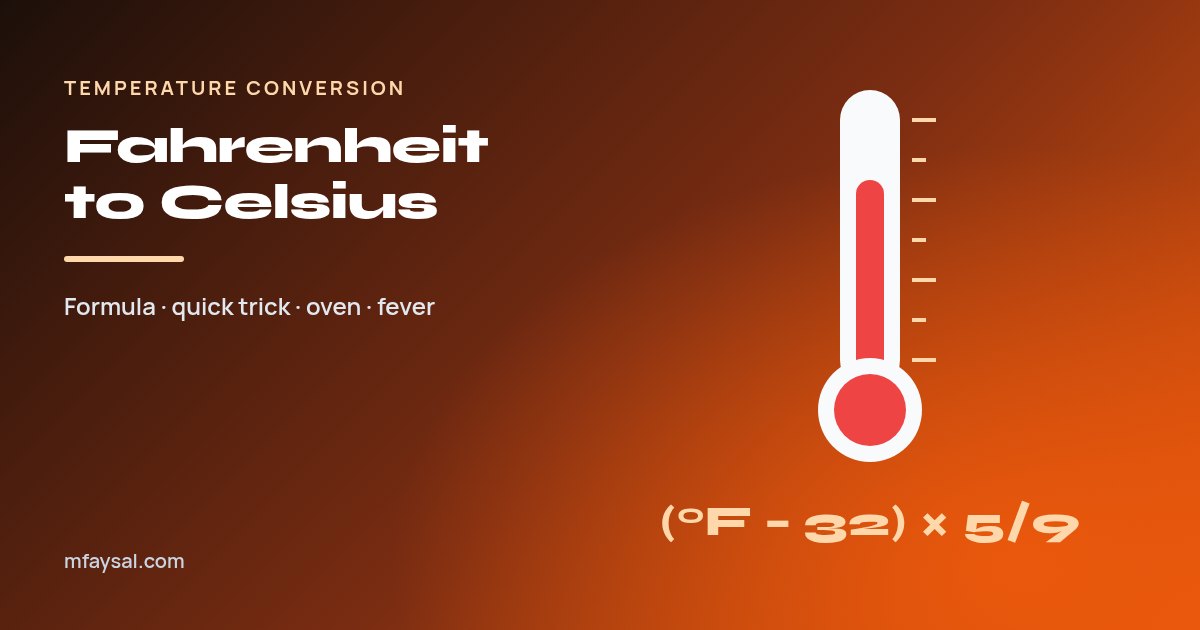
To convert Fahrenheit to Celsius, subtract 32 and multiply by 5/9: °C = (°F − 32) × 5 ÷ 9. For example, 68°F is (68 − 32) × 5 ÷ 9 = 20°C. For a quick estimate in your head, subtract 30 and halve the result.
This comes up constantly if you live in the UK and read American recipes, weather apps or medical advice, or if you're in the US and dealing with anything metric. The formula is easy once you see where it comes from, and the shortcut is close enough for weather but not for baking.
Below you'll find the exact formula, worked examples, the mental trick and when it fails, plus ready-made charts for weather, ovens and body temperature. If you just need a number, the Fahrenheit to Celsius converter does it instantly in both directions.
In this guide:
- The Fahrenheit to Celsius formula
- Why the formula uses 32 and 5/9
- Worked examples, step by step
- The quick mental trick: subtract 30, then halve
- Weather conversion chart (°F to °C)
- Oven temperatures: °F, °C, fan and gas mark
- Body temperature and fever in °F and °C
- Converting a temperature change, not a temperature
- The −40 crossover and other useful facts
- Fridge, freezer and food safety temperatures
- Common conversion mistakes
- Excel, Google Sheets and code formulas
- Frequently asked questions
The Fahrenheit to Celsius formula
There are two formulas, one for each direction:
- Fahrenheit to Celsius: °C = (°F − 32) × 5/9
- Celsius to Fahrenheit: °F = °C × 9/5 + 32
The order of operations matters. When going from Fahrenheit, you subtract 32 first, then multiply. When going to Fahrenheit, you multiply first, then add 32. Getting the order wrong is the single most common mistake.
If fractions feel awkward, 5/9 is about 0.5556 and 9/5 is exactly 1.8. So you can also write:
- °C = (°F − 32) ÷ 1.8
- °F = °C × 1.8 + 32
Both versions give identical answers. Use whichever is easier on your calculator.
Why the formula uses 32 and 5/9
The two scales put the freezing and boiling points of water (at standard sea-level pressure) in different places:
| Reference point | Fahrenheit | Celsius |
|---|
| Water freezes | 32°F | 0°C |
| Water boils | 212°F | 100°C |
| Gap between them | 180 degrees | 100 degrees |
Two things follow from that table:
- The scales are offset by 32. Fahrenheit's zero sits 32 degrees below freezing, so you remove that offset first.
- The degrees are different sizes. 180 Fahrenheit degrees cover the same range as 100 Celsius degrees, so one Fahrenheit degree is 100/180 = 5/9 of a Celsius degree.
Once you see it this way, you don't need to memorise the formula. You're just shifting the starting point and then rescaling. The same shift-then-rescale idea works for converting any value between two linear scales.
Worked examples, step by step
Here are four conversions worked out in full.
Example 1: a warm day, 77°F
- 77 − 32 = 45
- 45 × 5 = 225
- 225 ÷ 9 = 25°C
Example 2: a cold morning, 23°F
- 23 − 32 = −9
- −9 × 5 = −45
- −45 ÷ 9 = −5°C
Example 3: an American recipe, 350°F
- 350 − 32 = 318
- 318 × 5 = 1,590
- 1,590 ÷ 9 = 176.7, which recipes round to 180°C
Example 4: going the other way, 30°C to Fahrenheit
- 30 × 9 = 270
- 270 ÷ 5 = 54
- 54 + 32 = 86°F
Notice that negative numbers work exactly the same way. Anything below 32°F becomes a negative Celsius value.
The quick mental trick: subtract 30, then halve
For a rough answer without a calculator, use (°F − 30) ÷ 2. Going the other way, double the Celsius figure and add 30.
It works because 30 is close to 32, and halving is close to multiplying by 5/9 (0.5 instead of 0.556). Here's how close it gets:
| Fahrenheit | Exact °C | Quick trick °C | Error |
|---|
| 14°F | −10.0 | −8.0 | 2.0 warmer |
| 32°F | 0.0 | 1.0 | 1.0 warmer |
| 50°F | 10.0 | 10.0 | Exact |
| 68°F | 20.0 | 19.0 | 1.0 cooler |
| 86°F | 30.0 | 28.0 | 2.0 cooler |
| 104°F | 40.0 | 37.0 | 3.0 cooler |
| 350°F | 176.7 | 160.0 | 16.7 cooler |
The trick is spot on at 50°F and within about 2 degrees across normal weather. It gets worse the further you move from 50°F. That's fine for deciding whether to take a coat, but don't use it for ovens or for a child's temperature.
A neat memory aid: 16°C is 61°F and 28°C is 82°F. The digits swap, and both are exact to the nearest degree.
Weather conversion chart (°F to °C)
This chart covers the temperatures you'll see in UK and US weather forecasts. Values are exact to one decimal place.
| °F | °C | What it feels like |
|---|
| 0°F | −17.8°C | Severe cold |
| 14°F | −10.0°C | Very cold, hard frost |
| 32°F | 0.0°C | Freezing point |
| 41°F | 5.0°C | Cold winter day |
| 50°F | 10.0°C | Cool; jacket weather |
| 59°F | 15.0°C | Mild spring day |
| 68°F | 20.0°C | Comfortable room temperature |
| 77°F | 25.0°C | Warm summer day |
| 86°F | 30.0°C | Hot |
| 95°F | 35.0°C | Very hot |
| 104°F | 40.0°C | Extreme heat |
Every 9°F step is exactly 5°C, which is why the Celsius column goes up in neat fives from 14°F onwards.
Oven temperatures: °F, °C, fan and gas mark
American recipes use Fahrenheit, British recipes use Celsius (often with a lower fan figure) and older UK recipes use gas marks. Recipe charts round to convenient numbers rather than giving exact conversions.
| Gas mark | °F | °C (conventional) | °C (fan) |
|---|
| 1 | 275 | 140 | 120 |
| 2 | 300 | 150 | 130 |
| 3 | 325 | 160 | 140 |
| 4 | 350 | 180 | 160 |
| 5 | 375 | 190 | 170 |
| 6 | 400 | 200 | 180 |
| 7 | 425 | 220 | 200 |
| 8 | 450 | 230 | 210 |
| 9 | 475 | 240 | 220 |
These figures follow the Which? oven temperature conversion table. Some charts list gas mark 3 as 170°C; small differences like that are normal because the conversions are rounded.
Two practical points. First, fan ovens run hotter for the same setting, so reduce a conventional temperature by about 20°C. Second, American recipes almost always mean a conventional oven. So 350°F becomes 180°C conventional or about 160°C fan.
Body temperature and fever in °F and °C
Normal body temperature is often quoted as 98.6°F, which is exactly 37°C. In practice, normal temperature varies a little from person to person and through the day.
| °F | °C | Meaning |
|---|
| 97.0°F | 36.1°C | Within the normal range for many people |
| 98.6°F | 37.0°C | Commonly quoted "normal" |
| 100.4°F | 38.0°C | High temperature (fever) threshold used by the NHS |
| 102.2°F | 39.0°C | High fever |
| 104.0°F | 40.0°C | Very high fever |
The NHS says a high temperature in adults is usually 38°C or above. Note how the quick mental trick fails here: it turns 100.4°F into 35.2°C, which would wrongly suggest a low temperature. Always use the exact formula, or a converter, for medical readings, and follow official health advice rather than a chart if you're worried.
Converting a temperature change, not a temperature
This trips up even confident maths users. If a forecast says "10°F warmer than yesterday", that's a difference, not a reading. You don't subtract 32 for a difference, because the offset cancels out.
- Difference in °F to °C: multiply by 5/9 only. A 10°F rise is a 5.6°C rise.
- Difference in °C to °F: multiply by 9/5 only. A 3°C rise is a 5.4°F rise.
If you mistakenly used the full formula, a 10°F rise would become (10 − 32) × 5/9 = −12.2°C. That's obviously wrong, because temperatures don't fall when they rise. The same rule applies to climate figures: a 1.5°C rise in global temperature is a 2.7°F rise, not 34.7°F.
The −40 crossover and other useful facts
Fahrenheit and Celsius meet at exactly one point: −40°F equals −40°C. You can check it with the formula: (−40 − 32) × 5/9 = −72 × 5/9 = −40.
A few more handy facts:
- 0°F is −17.8°C. It's far colder than freezing.
- 100°F is 37.8°C, just above normal body temperature.
- Absolute zero is −273.15°C, or −459.67°F. Scientists use the Kelvin scale, where 0 K is absolute zero and K = °C + 273.15.
- For cooking by weight as well as by heat, our grams to pounds converter handles the other half of American recipes.
Fridge, freezer and food safety temperatures
Food safety advice is another place where UK and US sources use different scales, and where accuracy matters more than a quick estimate.
| What | UK guidance (°C) | US guidance (°F) | Same temperature converted |
|---|
| Fridge | 5°C or below | 40°F or below | 5°C = 41°F; 40°F = 4.4°C |
| Freezer | −18°C or below | 0°F or below | −18°C = −0.4°F |
| Poultry, cooked | Steaming hot; 70°C for 2 minutes | 165°F internal | 165°F = 73.9°C |
| Beef, pork or lamb steaks and roasts | Cook thoroughly (whole cuts of beef and lamb can be served pink) | 145°F, then rest 3 minutes | 145°F = 62.8°C |
| Minced meat | Cook until no pink remains | 160°F | 160°F = 71.1°C |
The US cooking temperatures come from the FoodSafety.gov chart of safe minimum internal temperatures; the 40°F fridge and 0°F freezer figures are standard US FDA advice, and the UK figures come from Food Standards Agency hygiene guidance. Notice that the two countries round in different ways: the US uses 40°F for the fridge, which is 4.4°C, slightly colder than the UK's 5°C.
If your kitchen thermometer only shows one scale, convert with the exact formula. A few degrees matters when you're checking whether chicken is cooked through.
Common conversion mistakes
- Multiplying before subtracting. 68 × 5/9 − 32 gives 5.8, not 20. Always subtract 32 first when converting from Fahrenheit.
- Using 9/5 instead of 5/9. If your Celsius answer is bigger than the Fahrenheit number for a normal warm day, you've flipped the fraction.
- Using the full formula for differences. A change of temperature only needs the 5/9 or 9/5 factor.
- Forgetting fan ovens. A US recipe at 350°F is about 160°C in a fan oven, not 180°C.
- Rounding too early. Keep the decimals until the last step, then round once.
Excel, Google Sheets and code formulas
If you have a column of temperatures to convert, use a formula rather than converting one at a time.
Excel and Google Sheets
With Fahrenheit in cell A2:
=(A2-32)*5/9
Excel also has a built-in function that does the same job:
=CONVERT(A2,"F","C")
For Celsius to Fahrenheit, use =A2*9/5+32 or =CONVERT(A2,"C","F"). Wrap any of them in ROUND(...,1) to show one decimal place.
JavaScript and Python
// JavaScript
const fToC = f => (f - 32) * 5 / 9;
fToC(68); // 20

# Python
def f_to_c(f):
    return (f - 32) * 5 / 9
Round only when you display the result. If you round in the middle of a calculation, small errors can build up, especially when converting back and forth.
Frequently asked questions
What is the formula to convert Fahrenheit to Celsius?
Subtract 32 from the Fahrenheit temperature, then multiply by 5/9. Written out, °C = (°F − 32) × 5 ÷ 9. For example, 68°F is 36 × 5 ÷ 9 = 20°C.
What is an easy way to convert Fahrenheit to Celsius in your head?
Subtract 30 and halve the result. It gives 19°C for 68°F against an exact answer of 20°C. It is good enough for weather but too rough for ovens or medical readings.
What is 350°F in Celsius?
350°F is 176.7°C exactly, which recipes round to 180°C for a conventional oven. In a fan oven use about 160°C, and on a gas cooker use gas mark 4.
What is 98.6°F in Celsius?
98.6°F is exactly 37°C, the commonly quoted normal body temperature. The NHS treats 38°C, or 100.4°F, and above as a high temperature in adults.
At what temperature are Fahrenheit and Celsius equal?
They are equal at minus 40. Minus 40°F and minus 40°C are the same temperature, which you can confirm with the formula: (−40 − 32) × 5/9 = −40.
How do I convert Celsius to Fahrenheit?
Multiply the Celsius temperature by 9/5, or 1.8, then add 32. For example, 25°C × 1.8 = 45, plus 32 gives 77°F.
Is 0°F colder than 0°C?
Yes. 0°F is about −17.8°C, which is much colder than the freezing point of water at 0°C, or 32°F.
How do I convert Fahrenheit to Celsius in Excel?
With the Fahrenheit value in A2, use =(A2-32)*5/9 or the built-in =CONVERT(A2,"F","C"). Use =ROUND(...,1) around it to show one decimal place.
Last checked: 19 October 2026. Figures, settings and guidance can change, so confirm anything important with the sources linked above.