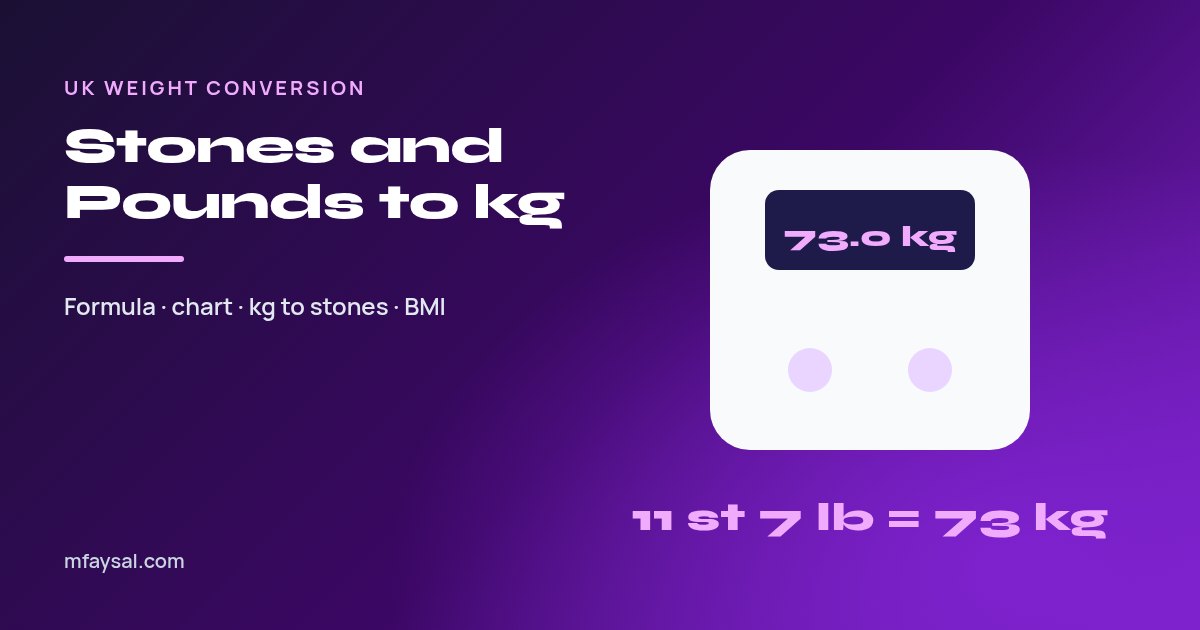
To convert stones and pounds to kilograms, turn everything into pounds first (stones × 14 + pounds), then multiply by 0.45359237. For example, 11 stone 7 pounds is (11 × 14 + 7) = 161 lb, and 161 × 0.45359237 = 73.0 kg. One stone is about 6.35 kg.
Stones are still how most people in the UK and Ireland talk about body weight, but GP surgeries, gyms, airlines and almost every health app work in kilograms. Americans, meanwhile, use pounds only, so a UK figure like "12 st 4" can be confusing on both sides of the Atlantic.
This guide explains the exact conversion, gives a full chart, walks through the trickier reverse conversion from kg back to stones and pounds, and shows how to use the result for BMI. If you'd rather skip the maths, the BMI calculator accepts stones and pounds directly.
In this guide:
- The stones and pounds to kg formula
- Where the numbers come from
- Worked examples
- Stones to kg chart (7 to 20 stone)
- How to convert kg back to stones and pounds
- kg to stones and pounds chart
- Quick mental shortcuts
- Using your weight for BMI
- Stones, pounds and kilograms around the world
- Getting a reliable weight before you convert
- Excel and Google Sheets formulas
- Frequently asked questions
The stones and pounds to kg formula
There are two equivalent methods. Both give the same answer.
- Method 1 (via pounds): kg = (stones × 14 + pounds) × 0.45359237
- Method 2 (via stones): kg = (stones × 6.35029318) + (pounds × 0.45359237)
Method 1 is easier on a phone calculator because there's only one awkward number. Method 2 is handy if you've memorised that a stone is about 6.35 kg.
Round only at the end. For body weight, one decimal place (73.0 kg) is plenty, and most bathroom scales are only accurate to about that level anyway.
If you need grams, for example for a baby's weight or a parcel, multiply the kilograms by 1,000. For smaller weights in pounds and ounces, the grams to pounds converter works in both directions.
Where the numbers come from
A stone is defined as exactly 14 pounds. A pound has been defined as exactly 0.45359237 kg since the international yard and pound agreement of 1959, which the UK and the US both adopted.
Both definitions appear in UK law, in Schedule 1 of the Weights and Measures Act 1985, which lists the stone as 14 pounds and the pound as 0.453 592 37 kilogram. The schedule also lists the stone among units that can't be used for trade except as a supplementary indication. That's why shops sell in grams and kilograms even though people still weigh themselves in stones.
Multiply the two together and a stone works out at 14 × 0.45359237 = 6.35029318 kg. That's the exact figure; 6.35 is the everyday rounded version.
Because both values are exact definitions, any difference between two converters comes down to rounding, not to different standards.
Worked examples
Example 1: 9 stone 3 pounds
- 9 × 14 = 126 lb, plus 3 = 129 lb.
- 129 × 0.45359237 = 58.5 kg.
Example 2: 12 stone 9 pounds
- 12 × 14 = 168 lb, plus 9 = 177 lb.
- 177 × 0.45359237 = 80.3 kg.
Example 3: 10 and a half stone
Half a stone is 7 pounds, so 10½ stone is 10 st 7 lb.
- 10 × 14 = 140, plus 7 = 147 lb.
- 147 × 0.45359237 = 66.7 kg.
Example 4: 18 stone
- 18 × 14 = 252 lb.
- 252 × 0.45359237 = 114.3 kg.
Notice that "10.5 stone" and "10 stone 5 pounds" are different weights. 10.5 stone is 10 st 7 lb (66.7 kg), while 10 st 5 lb is 145 lb (65.8 kg). The decimal is a fraction of a stone, not a number of pounds.
Stones to kg chart (7 to 20 stone)
Whole stones, with total pounds and kilograms rounded to one decimal place.
| Stones | Pounds | Kilograms |
|---|
| 7 st | 98 lb | 44.5 kg |
| 8 st | 112 lb | 50.8 kg |
| 9 st | 126 lb | 57.2 kg |
| 10 st | 140 lb | 63.5 kg |
| 11 st | 154 lb | 69.9 kg |
| 12 st | 168 lb | 76.2 kg |
| 13 st | 182 lb | 82.6 kg |
| 14 st | 196 lb | 88.9 kg |
| 15 st | 210 lb | 95.3 kg |
| 16 st | 224 lb | 101.6 kg |
| 17 st | 238 lb | 108.0 kg |
| 18 st | 252 lb | 114.3 kg |
| 20 st | 280 lb | 127.0 kg |
For anything in between, add 0.45 kg for each extra pound. For example, 12 st 4 lb is 76.2 + (4 × 0.4536) = 78.0 kg.
How to convert kg back to stones and pounds
The reverse conversion has one extra step, and it's where most mistakes happen.
- Divide the kilograms by 0.45359237 to get total pounds. (Or multiply by 2.20462.)
- Divide the total pounds by 14. The whole number is the stones.
- Find the leftover pounds: total pounds minus (stones × 14). Round to the nearest pound.
Example: 80 kg.
- 80 ÷ 0.45359237 = 176.4 lb.
- 176.4 ÷ 14 = 12.6, so 12 stone.
- 176.4 − 168 = 8.4, which rounds to 8 lb.
So 80 kg is about 12 st 8 lb.
The classic mistake is reading 12.6 stone as "12 stone 6 pounds". The .6 is six-tenths of a stone, which is 0.6 × 14 = 8.4 pounds. Never read the decimal part of stones as pounds.
Also watch for rounding up to 14 pounds. 95 kg is 209.4 lb, which is 14 stone and 13.4 lb; that rounds to 14 st 13 lb. But 95.2 kg is 209.9 lb, which would round to "14 st 14 lb". Write that as 15 st 0 lb.
kg to stones and pounds chart
Common metric weights converted back, with leftover pounds to one decimal place.
| Kilograms | Total pounds | Stones and pounds |
|---|
| 50 kg | 110.2 lb | 7 st 12.2 lb |
| 55 kg | 121.3 lb | 8 st 9.3 lb |
| 60 kg | 132.3 lb | 9 st 6.3 lb |
| 65 kg | 143.3 lb | 10 st 3.3 lb |
| 70 kg | 154.3 lb | 11 st 0.3 lb |
| 75 kg | 165.3 lb | 11 st 11.3 lb |
| 80 kg | 176.4 lb | 12 st 8.4 lb |
| 85 kg | 187.4 lb | 13 st 5.4 lb |
| 90 kg | 198.4 lb | 14 st 2.4 lb |
| 100 kg | 220.5 lb | 15 st 10.5 lb |
| 110 kg | 242.5 lb | 17 st 4.5 lb |
| 120 kg | 264.6 lb | 18 st 12.6 lb |
A handy anchor: 70 kg is almost exactly 11 stone, and 100 kg is a little under 15 st 11 lb.
Quick mental shortcuts
Without a calculator, these rough rules get you close:
- 1 stone ≈ 6.35 kg. Multiply stones by 6.35 and add about 0.45 kg per pound.
- Stones × 6.4 is a decent single-step estimate. 11½ stone × 6.4 = 73.6 kg against an exact 73.0 kg.
- Avoid stones × 6. It's easy, but 11½ stone × 6 = 69 kg, about 4 kg too light.
- kg to pounds: double the kg and add 10%. 80 kg → 160 + 16 = 176 lb, against an exact 176.4 lb.
For tracking weight loss or a medical record, use the exact conversion. A 1 or 2 kg error is bigger than many people's week-to-week change.
Using your weight for BMI
BMI is your weight in kilograms divided by your height in metres squared: BMI = kg ÷ m². That's why it helps to convert stones to kg first.
Example: 11 stone (69.9 kg) and 5 ft 9 in (1.753 m). BMI = 69.9 ÷ (1.753 × 1.753) = 69.9 ÷ 3.073 = 22.7.
| BMI | NHS category for most adults |
|---|
| Below 18.5 | Underweight |
| 18.5 to 24.9 | Healthy weight |
| 25 to 29.9 | Overweight |
| 30 or more | Obese |
The NHS guidance on overweight and obesity uses lower thresholds for people from South Asian, Chinese, other Asian, Middle Eastern, Black African or African-Caribbean backgrounds: 23 to 27.4 is overweight and 27.5 or more is obese. BMI can't tell muscle from fat, so it's a screening number, not a diagnosis. Talk to a GP or pharmacist if you're worried about your weight.
Stones, pounds and kilograms around the world
Different countries talk about body weight in different units, which is why conversions come up so often:
| Country | Everyday body weight | Official and medical use |
|---|
| United Kingdom | Stones and pounds (often kg among younger people) | Kilograms |
| Ireland | Stones and pounds or kg | Kilograms |
| United States | Pounds only | Pounds in everyday care; kg in science and many clinical records |
| Most other countries | Kilograms | Kilograms |
So if an American says they weigh 160 lb, that's 11 st 6 lb in UK terms, or 72.6 kg for everyone else. To convert US pounds to stones, divide by 14: 160 ÷ 14 = 11.43, so 11 stone and 0.43 × 14 = 6 lb.
Getting a reliable weight before you convert
A precise conversion is only as good as the number you start with. Home scales vary, and body weight naturally moves up and down by a kilogram or more across a day because of food, drink and water.
- Weigh at the same time of day, ideally in the morning after using the toilet and before eating.
- Use the same scales on a hard, level floor. Carpet can make some scales read differently.
- Wear similar clothing, or none. Shoes and heavy clothes can add a kilo or more.
- Look at the trend, not a single reading. A weekly average tells you far more than one day's number.
- Pick one unit and stick to it for tracking. Switching between stones and kilograms makes small changes harder to spot.
Many digital scales let you switch between st, lb and kg with a button underneath. If yours does, there's no need to convert by hand at all.
Excel and Google Sheets formulas
With stones in column A and pounds in column B:
=(A2*14+B2)*0.45359237
Or with the built-in conversion function, which knows both units:
=CONVERT(A2*14+B2,"lbm","kg")
To go from kilograms in C2 back to text such as "12 st 8 lb", round to whole pounds first so you never get 14 pounds:
=INT(ROUND(C2/0.45359237,0)/14)&" st "&MOD(ROUND(C2/0.45359237,0),14)&" lb"
For 80 kg this returns "12 st 8 lb", and for 95.2 kg it returns "15 st 0 lb".
The same logic in JavaScript:
function kgToStone(kg) {
  const lb = Math.round(kg / 0.45359237);
  return `${Math.floor(lb / 14)} st ${lb % 14} lb`;
}
kgToStone(80); // "12 st 8 lb"
Frequently asked questions
How do I convert stones and pounds to kg?
Multiply the stones by 14 and add the pounds to get total pounds, then multiply by 0.45359237. For example, 11 st 7 lb is 161 lb, and 161 × 0.45359237 = 73.0 kg.
How many kg is 1 stone?
One stone is exactly 6.35029318 kg, usually rounded to 6.35 kg. That comes from 14 pounds × 0.45359237 kg per pound.
How many kg is 10 stone?
10 stone is 140 pounds, which is 63.5 kg.
What is 70 kg in stones and pounds?
70 kg is 154.3 pounds, which is 11 stone and 0.3 pounds, so it is almost exactly 11 stone.
How do I convert kg to stones?
Divide the kg by 0.45359237 to get pounds, then divide by 14. The whole number is stones, and the remainder multiplied by 14 gives the leftover pounds. 80 kg is 176.4 lb, which is 12 st 8 lb.
Is 12.5 stone the same as 12 stone 5 pounds?
No. 12.5 stone means twelve and a half stone, which is 12 st 7 lb, or 79.4 kg. 12 st 5 lb is 173 lb, or 78.5 kg.
How many pounds are in a stone?
There are exactly 14 pounds in a stone. Half a stone is 7 pounds and a quarter of a stone is 3.5 pounds.
Why do people in the UK still use stones?
Stones remain a common habit for body weight in the UK and Ireland, but they are not used for trade. Shops, the NHS and most official records use kilograms, which is why converting between the two is so common.
Last checked: 19 October 2026. Figures, settings and guidance can change, so confirm anything important with the sources linked above.